Small tools, honest tools
Why TheTensor ships single-file, local-first software with a course built in — and why a bilingual interface is a feature, not an afterthought. Plus what is coming next.
Software has been drifting in an annoying direction for a decade. Tools that used to be programs became accounts. Accounts became subscriptions, and the programs themselves moved to someone else's computer, where you cannot read them, audit them, or use them on a plane. For most categories that is a trade people accepted. For a tool that touches your datasets and trains your models, we think it is the wrong trade — and TheTensor exists as a small counter-argument.
Local-first is a feature you can feel
Everything TheTensorTune does, it does on your machine. Your datasets live in a folder you can see. Your run history lives in a small SQLite file you can open with any tool. The only network traffic is the model download from Hugging Face, and even that can go through a mirror if your network prefers one. When a tool works this way, questions like “who else has my data?” stop needing answers, because the answer is nobody. That is a kind of privacy policy no terms-of-service page can match.
There is a second, quieter benefit. A tool that runs locally is a tool you can trust by reading it. The whole workbench is one Python file — open it in any editor and the entire surface area is in front of you: the API routes, the training loop, the export. We like software where “what does it do?” has an answer you can check yourself.
Docs that live where the tool lives
Most documentation is a website you visit once, in a hurry, while something is on fire. We took the other road: a twelve-lesson visual course ships inside the app, next to the thing it teaches, with screenshots from the same version you are running. It covers everything from your first dataset upload to wiring training into your own scripts with the REST API. When the app updates, the course updates with it — documentation that cannot drift out of date because it cannot leave home.
Bilingual by design, not by plugin
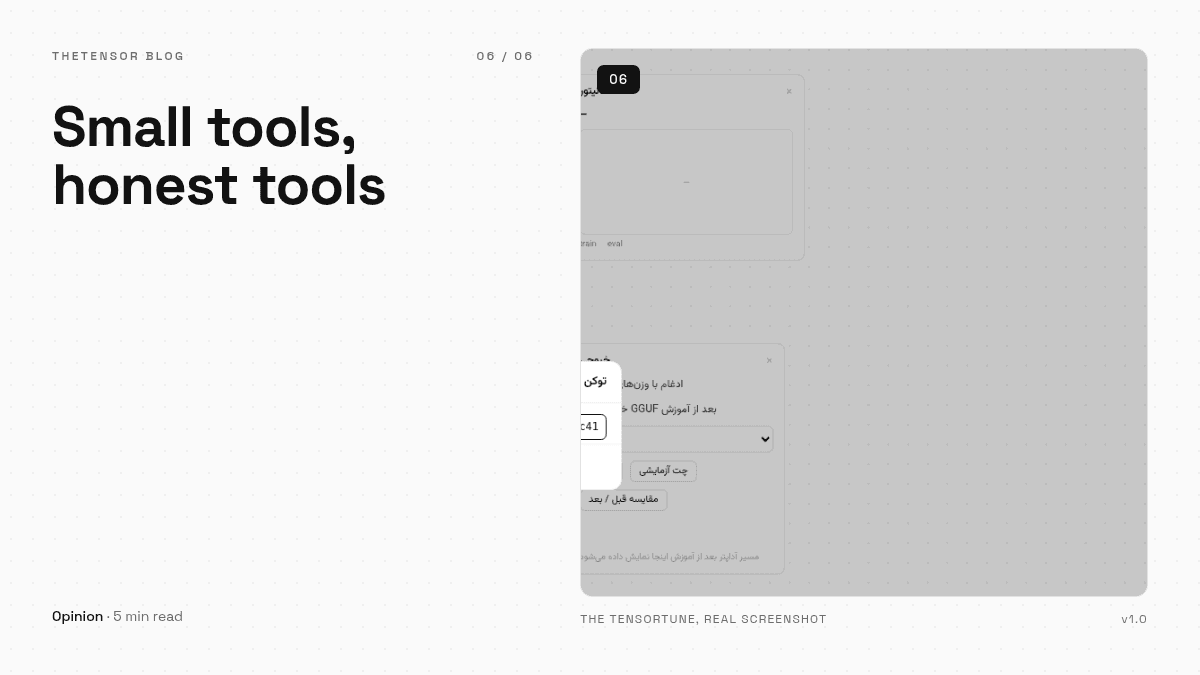
The interface speaks English and Persian natively — one key press flips every label, modal and lesson into full right-to-left Persian, and the choice sticks. That is not a localization afterthought; it is a design decision. Half the team thinks in Persian, and a huge number of people fine-tuning models today work in languages the big tools treat as edge cases. Persian datasets with emoji pass through the quality reports and the training loop as first-class citizens. A tool should speak its users' language, not the other way around.
What is next
More tools under the same flag: small, single-file, local-first things that each do one job well. TheTensorTune 1.0 is the first public release, and the roadmap from here is shaped by what people actually ask for on Telegram and GitHub — which is a roundabout way of saying: tell us what you need. The conversation is the roadmap.